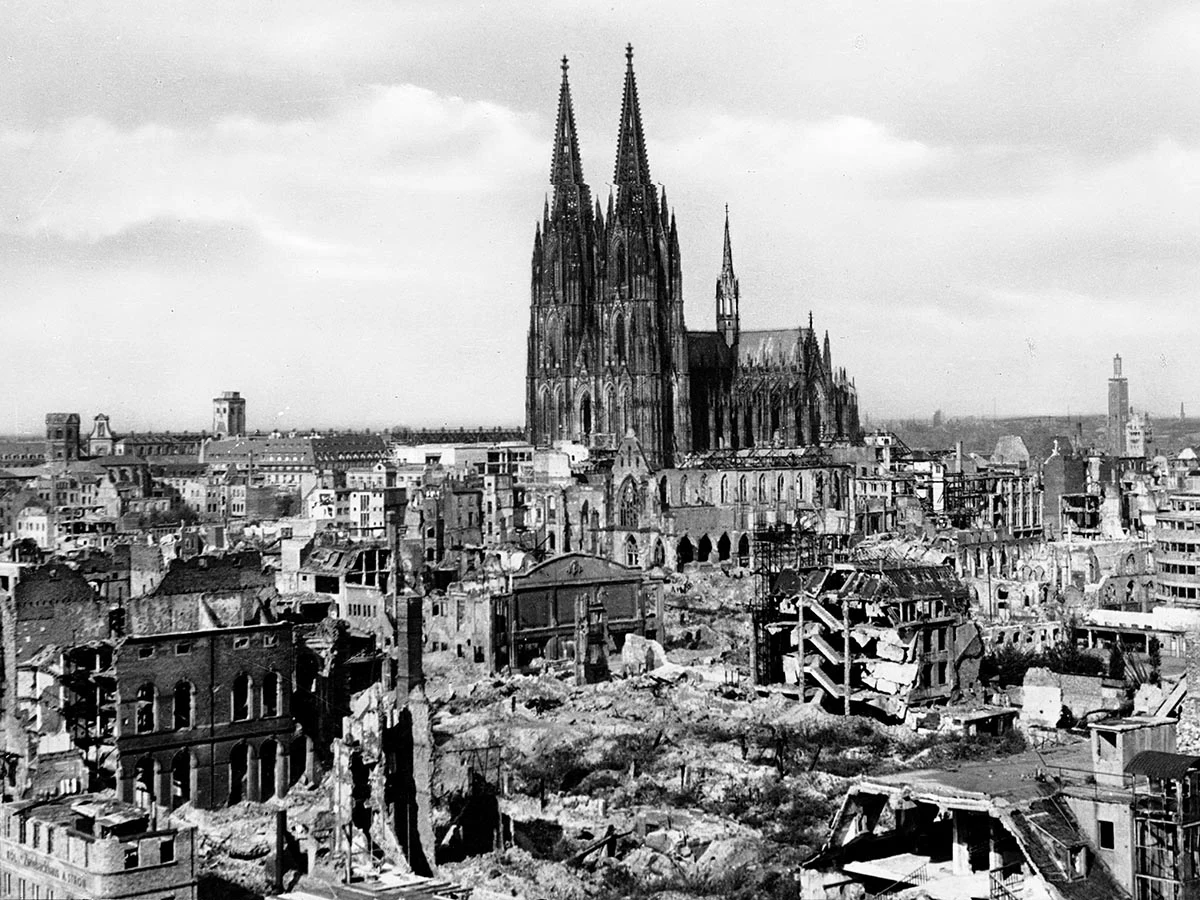
To the invading liberation troops, Cologne shows itself as a dead city of ruins. In 1945, Konrad Adenauer resumed his duties as mayor. Already in early summer, many Cologne residents return to the city.

Following the British model, the Cologne City Constitution of 1946 is introduced, the CDU is with over 53% driving political force. Cologne now belongs to the newly founded North Rhine-Westphalia
Through the Cathedral Festival in 1948 on the 700th anniversary of the laying of the foundation stone, Cologne’s historical significance was brought back to consciousness. From 1948, trains can travel again over the temporary Hohenzollern Bridge, the Deutzer Bridge is newly built.
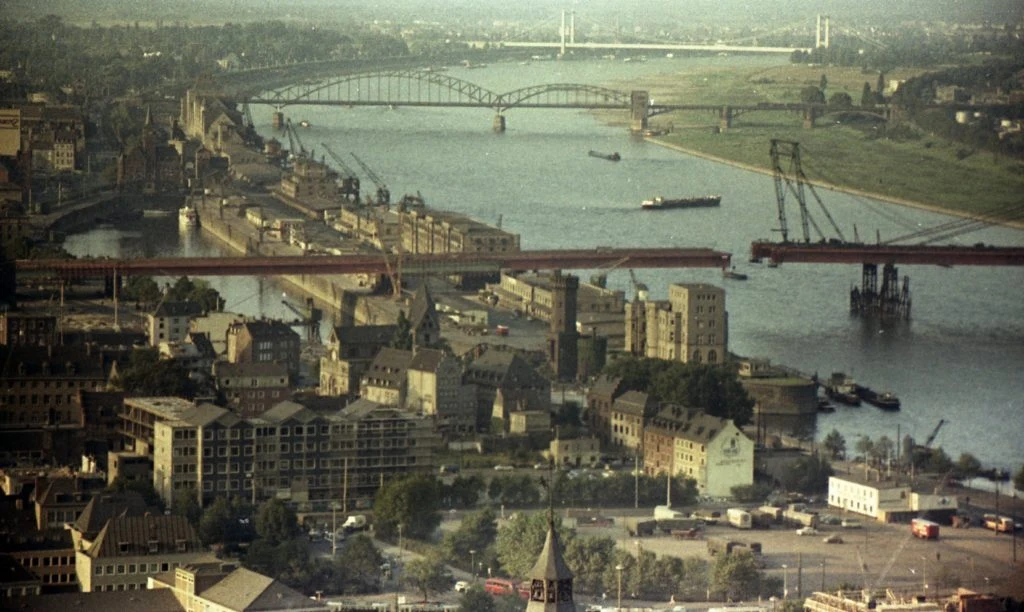
In 1959, in the presence of Cardinal Frings and Chancellor Adenauer, the Severins Bridge is inaugurated, and the Severinstraße underground station is also opened.

In the post-war period, the urban area expanded to more than 40 ha.
Sources:
Carl Dietmar, Werner Jung: Cologne. The great city history, Klartext Verlag, Essen 2015
https://de.wikipedia.org/wiki/K%C3%B6ln https://de.wikipedia.org/wiki/Geschichte_der_Stadt_K%C3%B6ln https://www.koeln.de/ausstellungen/geplante_ausstellungen/koeln-in-unheiligen-zeiten-die-stadt-im-dreissigjaehrigen-krieg_844635.html https://de.wikipedia.org/wiki/Franzosenzeit https://www.ksta.de/koeln/koeln-im-18--jahrhundert-kluengel--suff-und-gottesfurcht-3965100 https://koeln-magazin.info/nationalsozialismus.html https://de.wikipedia.org/wiki/Joseph_Frings https://www.fwg-koeln.de/ueber-uns/fwg-geschichte