The Middle Ages
Archbishops now play a major role in Cologne, with Archbishop being a title, not a title of office. The understanding and tasks of an archbishop are very different worldwide. In Cologne, he now also takes on secular tasks. In 953 Bruno becomes Archbishop of Cologne (brother of Frankish King Otto I) and decisively reshapes the cityscape. Cologne is called “Holiday Cologne”.
Around 870 various collegiate churches are founded, including St. Severin. Around 930 St. John Baptist was founded. A monastery is a religious association, which is mostly equipped with real estate, especially in Austria, many monasteries are called monasteries. A women's association, for example, is a religious community for women who live in a monastery-like facility without taking vows.
A city wall in length of 7.5 km with 22 gates is built. Monasteries and churches shape the cityscape and strengthen faith and learning in the city. Epidemics of plague still haunt the city. There is a cooperative principle of coexistence of the sexes, guilds and gaffes. The Cologne economy is of European rank, determined among other things by the stacking right. This was a kind of pre-emption right on incoming goods, which the traders in the port had to transfer to other ships (the Rhine was not navigable consistently with the same type of ship).
“Cologne” becomes the epitome of quality.
The bones of the three kings (now also city patrons of Cologne, concealed in the city coat of arms by the three crowns). Among other things, this is the pulse generator 1248 to lay the foundation stone for the construction of the cathedral.
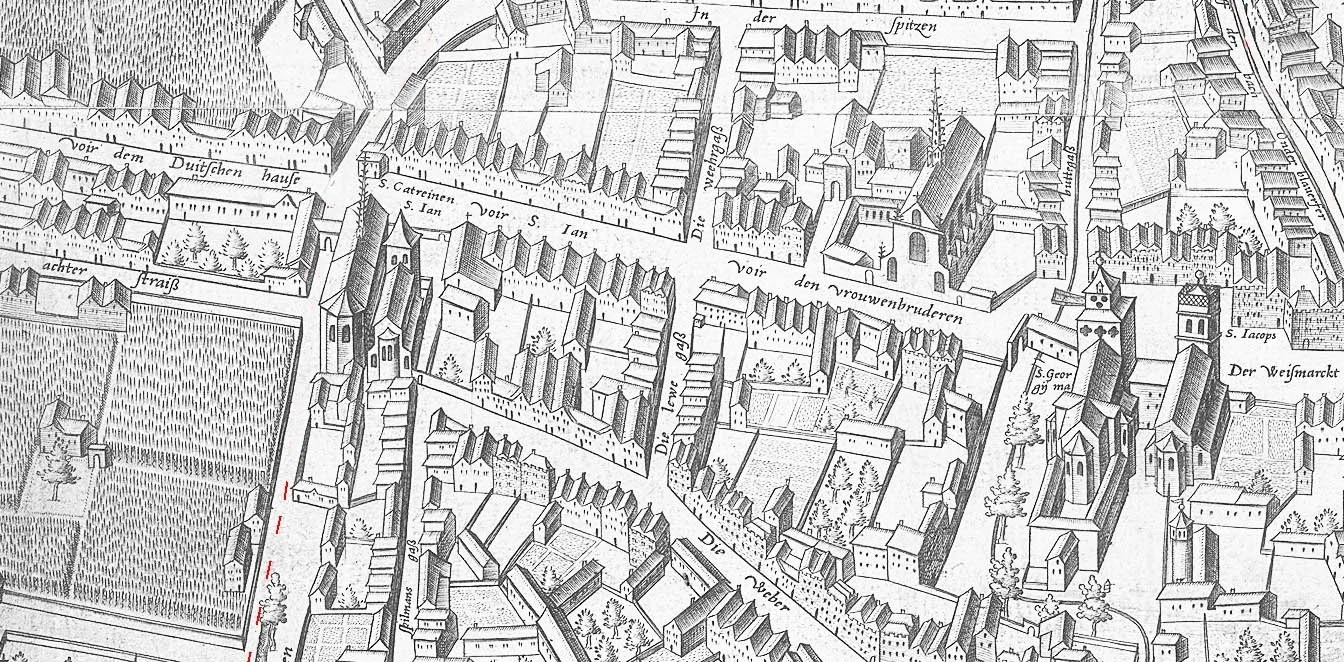
In the Middle Ages, Severinstraße acted as a gateway and was already the lifeline of the district. It belonged within the suburban district Oversburg to Church play St. Severin and is named after the holy Severin of Cologne the third named bishop of the city. This develops into a street of churches, monasteries and chapels (e.g. St. Severin, St. John Baptist, St. Joseph and Theresia, St. Gregorius, St. Catherine, Monasteries of Carmelite Women). So it was called by the Cologne also “Paffengasse”. At that time, however, the Severinstraße is also called Burgstraße, because it was built from the Hohe Pforte to the Old castle (‘Burgum vetus’) in Marienburg led.
The Severinstorburg is one of the 5 landward gates that are open during the day.


Cologne as a free imperial city: Reformation until the 30-year war
In the 17th century, Europe is in a state of emergency. Religious fanaticism, death and devastation increase to disaster. From 1618 to 1648, the Catholic League fought with the Emperor against the Evangelical Union. At the European level, the Habsburgs in Spain and Austria are fighting against France and the Protestant powers: the United Netherlands, Denmark and Sweden. War campaigns, famines and pestilences depopulate entire regions.
Since Cologne is largely concerned with neutrality, the city is largely spared. It even capitalizes on the misfortunes of others. There is a flourishing trade in war-important goods in Cologne. Including weapons for all warring parties.
However, Cologne does not get through this dark chapter of history completely unscathed. During the siege of Deutz in 1632 by Lieutenant General Wolf Heinrich Graf zu Baudissin, a major explosion occurred. A powder magazine exploded, 300 people are said to have lost their lives. For the Cologne Südstadt this disaster is very far away, on the other, the wrong Rhine side (“schäl sick”).
Only the history of Jan van Werth is not forgotten in the south of Cologne to this day. The servant Jan von Kümpchenshof wooed the love of the market woman Griet. She rejects his love because he is not fine enough for her. Jan then goes into the 30-year war and comes back after years as a famous general and general Jan von Werth. Griet regrets having rejected Jan at that time and speaks the historical words: "Jan, wer etätt jewoss!" (highly German: Jan, who would have known). But Jan rejects them with the words: "Griet, wer etätt jedonn!" (highly German: Griet, who did it).
The history game is traditionally performed on Weiberfastnacht at 1:30 pm at the Severinstorburg. Following the historic piece, a move from the Southern city to the monument "Jan von Werth" on Old market.
A witness baroque splendor can be found on the Severinstr. Since 1676 is located at the beginning of the Severinstr. Haus BalchemBuilt by the beer brewer Heinrich Deutz. It is considered the most beautiful preserved baroque house in the city, its name is reminiscent of the former brewery “Kartäu Bräu Gebr. Balchem” in the house. Today the district library is located there.
Cologne in the 18th century until French rule
Cologne enjoys a dubious reputation in the 18th century. Visitors report that the beautiful sight from the river side does not match the interior at all. Backwardness, dirt, unspeakable poverty and religious intolerance deter visitors. The cathedral is unfinished, looks like a huge pile of ruins, does not correspond at all to the taste of time. Gothic (the epitome of modernity in the Middle Ages) has become a curse word, derived from the Goths, the “barbarians”. A Swiss physician (Albrecht von Haller) states in 1725 that the people of Cologne were at least a century behind the rest of the Germans.

City constitution, guild system, sluggish economic policy and rigorous confessional policy prevent further development. The unloved other side of the Rhine benefits from this: in 1714, nine wealthy Protestant families of manufacturers and merchants leave the city and settle in Mülheim. What today is benevolently referred to as the “Kölner Klüngel” is already evident in the fact that only five families in the 18th century make up more than half of all mayors. The same names always appear in the three-year rhythm.
Under French rule, a lot changes in Cologne. Between 1792 and 1815 (time of the Napoleonic wars) France rules over large parts of Europe, Cologne is also affected.
Although the crew is of course also perceived as depressing, the Cologneers benefit from it. Numerous prohibitions and exhortations (on the occasion of Napoleon’s first visit to Cologne, the inhabitants are exhorted to keep the pigs away from the roads that the emperor will pass) are said to combat pollution. At some point, the unruly people of Cologne also adhere to it.
What remains in memory of this time is also the continuous numbering of the houses (1796). Glockengasse 4711 has become a trademark today. A first Cologne address book is created.
Carnival also benefits from this time. After an initial ban on the street carnival, the carnival is established as an economic factor (permits must be obtained for mask balls, etc.)
To this day, carnival is an indispensable economic engine in Cologne’s Südstadt.
The secularization emanating from the French also takes hold in the south of Cologne: numerous monasteries dissolved. Today’s Friedrich Wilhelm Gymnasium was a Carmelite monastery. Several beer breweries are also set up on Severinstraße, including the Reissdorff brewery. The hospital of Augustinnerinnen is being built.
Departure to a modern city
After the Franco-German War of 1870/1871, Cologne also experienced a great economic and industrial upswing. The Rheinauhafen is put into operation and a tram network is created. The population of Cologne is rising sharply during this time. Since the medieval city wall is largely demolished from 1881, the city can be significantly expanded
Important for this time is also the completion of the Cologne Cathedral 1842 to 1880. The facade plans of the Cologne Cathedral had been rediscovered, Goethe admired Gothic architecture, the cathedral became the symbol of a German national movement. The Prussian King Friedrich Willhelm IV also became a supporter.
The Severinstraße already formed the main axis of the Severinsviertel (on kölsch "Vringsveedel"). It is the main shopping street for the factory workers of Südstadt. The chocolate factory Stollwerck opened in 1872 is an important employer.
Sources:
Carl Dietmar, Werner Jung: Cologne. The great city history, Klartext Verlag, Essen 2015
https://de.wikipedia.org/wiki/K%C3%B6ln https://de.wikipedia.org/wiki/Geschichte_der_Stadt_K%C3%B6ln https://www.koeln.de/ausstellungen/geplante_ausstellungen/koeln-in-unheiligen-zeiten-die-stadt-im-dreissigjaehrigen-krieg_844635.html https://de.wikipedia.org/wiki/Franzosenzeit https://www.ksta.de/koeln/koeln-im-18--jahrhundert-kluengel--suff-und-gottesfurcht-3965100 https://koeln-magazin.info/nationalsozialismus.html